
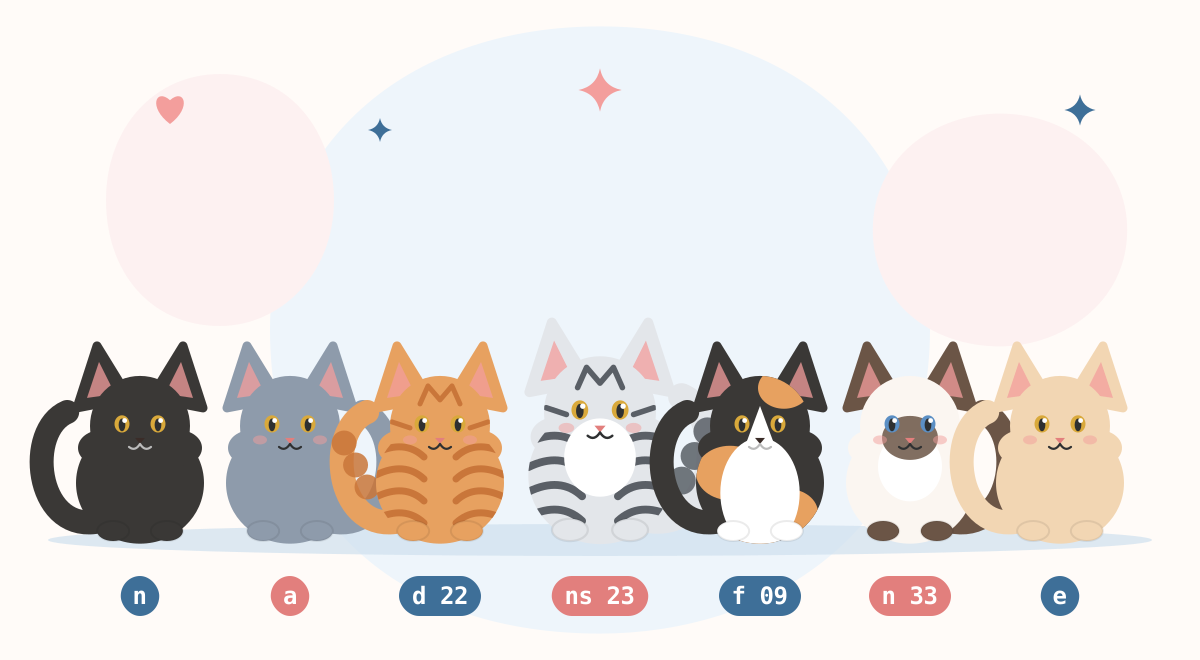
Every time one of our queens is expecting, the whole house plays the same guessing game: "What colours will we get this time?" A black boy? A silver girl? Maybe a little colourpoint with blue eyes? The fun part is that it isn't really a guess. Cat colour follows a handful of surprisingly simple rules – and once you know them, you can predict a litter with pen and paper.
So here they are, in plain language. At the bottom of this guide there's a predictor: choose your breed and the colours of mum and dad, and it shows every kitten colour they can have, the chance of each, long hair or short – and the EMS code you'll need for registration. You can also use it just to look up the code for your own cat.
The one idea that explains everything
For every colour gene, a kitten gets one copy from mum and one from dad. Some versions of a gene are dominant – one copy is enough to show. Others are recessive – they only show when the kitten gets a copy from both parents. A cat with one hidden copy is called a carrier: it looks perfectly ordinary, but it can pass that gene on.
That's why two black cats can surprise you with a blue kitten, and two shorthairs can have a fluffy longhair. Nothing went wrong – both parents were quietly carrying it all along. 😊
Long hair or short hair?
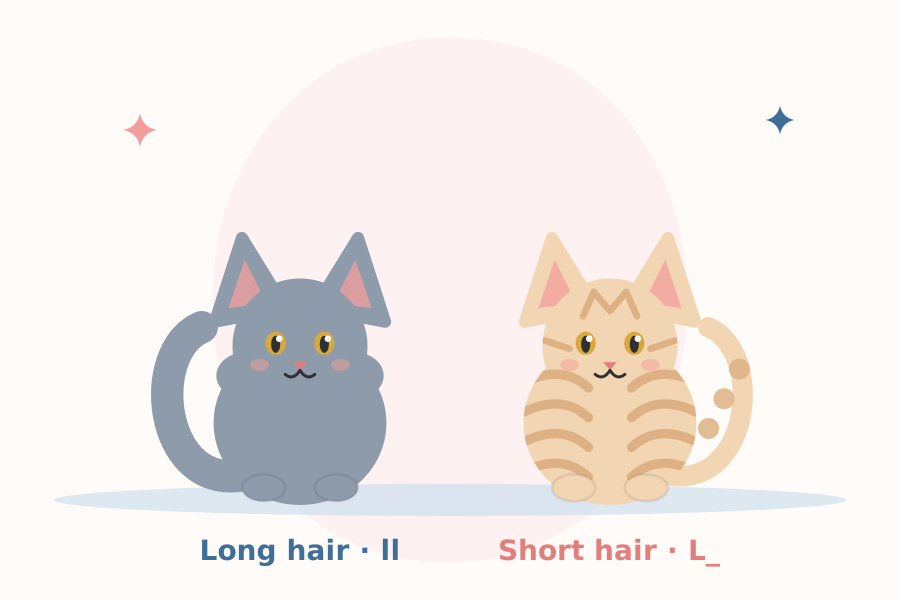
Short hair is dominant, long hair is recessive. That gives three easy rules:
- Two longhairs (like two Siberians) can only have long-haired kittens.
- Two shorthairs can have a longhair kitten only if both carry long hair – then about one kitten in four is fluffy.
- A longhair and a shorthair have all short-haired kittens, unless the shorthair carries long hair – then it's roughly half and half.
"Long hair" covers everything from semi-long Siberians to full Persian coats – the exact length and density come from many smaller genes and from the breed. That's why Siberian kittens look like fluff balls but only get their full adult coat at three to five years.
The base colours: black, chocolate, cinnamon – and their pale versions
Under all the patterns, every cat has one of three base colours, from the same gene:
The most dominant. Called "seal" in colourpoints and "brown" in tabbies. EMS letter n.
Recessive to black. EMS letter b.
Recessive to both. A warm, reddish brown. EMS letter o.
Then there's a second gene, dilution, which is recessive. A kitten with two copies gets a soft, "washed-out" version of its colour:
| Full colour | Diluted | EMS |
|---|---|---|
| Black (n) | Blue – soft grey | a |
| Chocolate (b) | Lilac – pinkish dove grey | c |
| Cinnamon (o) | Fawn – warm beige | p |
| Red (d) | Cream | e |
Red, cream and tortie: the boy–girl rule
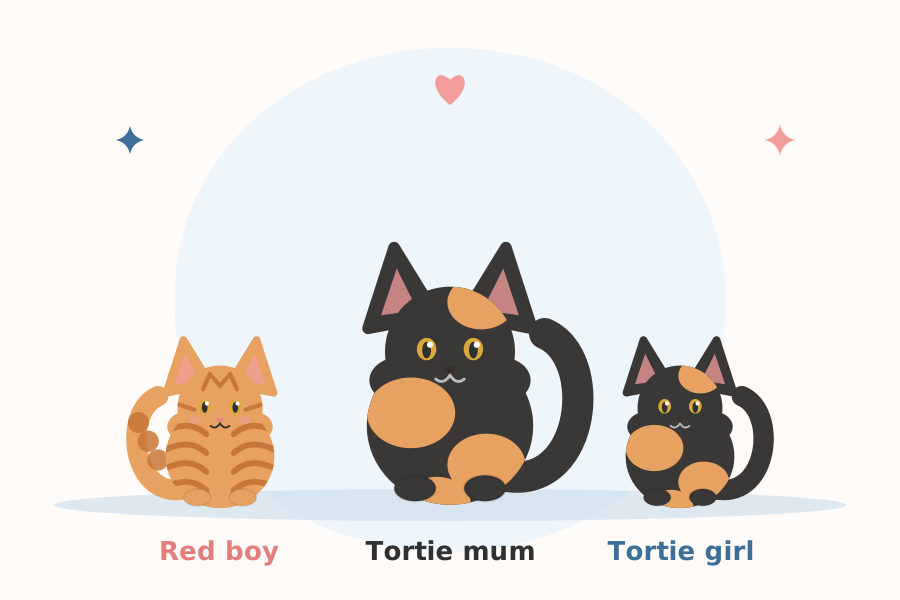
Red (ginger) is the odd one out. Its gene sits on the X chromosome – and that changes everything:
- Boys have one X, from their mum. So a boy is either red or not red – his mother decides, dad has no say at all.
- Girls have two X's, one from each parent. One red X and one non-red X makes a tortie – a patchwork of red and black (or cream and blue).
- That's why torties are almost always girls. A tortie boy needs an extra X chromosome – it happens, but only about once in three thousand, and those boys are usually sterile.
A quick example: a tortie mum and a black dad can have red boys and black boys, and tortie girls and black girls – but never a red girl, because dad has no red to give.
Add white and a tortie becomes what most people call a calico – in EMS terms, tortie and white.
Tabby or solid?
The tabby pattern is there in every cat, but a gene called agouti decides whether you see it. Tabby (agouti) is dominant; solid colour is recessive. So two tabbies can have a solid kitten if both carry solid – but two solid cats can never have a tabby (with one exception: red and cream cats always show some ghost stripes, even when they're genetically solid).
The type of tabby comes from other genes:
Bold swirls, with a "bullseye" on the side. Recessive.
Thin "tiger" stripes. Spotted is a mackerel whose stripes are broken into spots.
No stripes on the body, just banded hairs – like an Abyssinian. Dominant over the others.
Silver, smoke and golden
The silver gene (the inhibitor) takes the warm colour out of the base of each hair and leaves it white. It's dominant, so a silver kitten always has at least one silver parent.
- Silver + tabby = silver tabby – crisp black stripes on a bright white-silver background. EMS letter s, e.g.
ns 22. - Silver + solid = smoke – the cat looks solid until it moves and you see the white roots. Also s, e.g.
ns. - Golden is the warm opposite – a tabby with a rich apricot undercoat. In Siberians it comes from a recessive gene called sunshine, so both parents must carry it. EMS letter y.
Shaded and shell (the very light "chinchilla" look, EMS 11 and 12) come from many small genes on top of silver or golden, so no calculator can predict them exactly.
White: all-white, and white patches
There are two completely different "white" genes:
- Dominant white (EMS
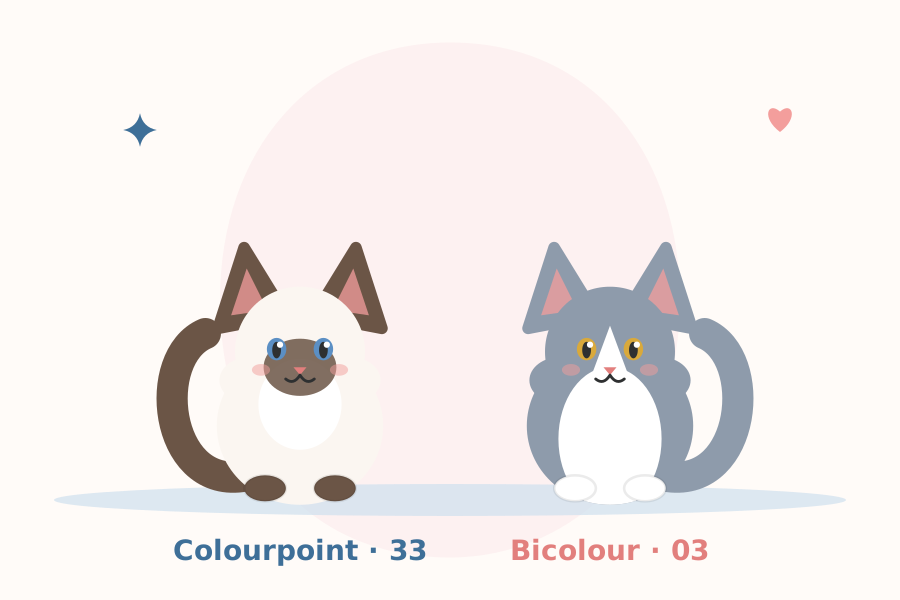
w) covers the whole cat like a sheet. Underneath, the cat still has a "real" colour that it passes on to its kittens. One white parent usually means about half the litter is white. White cats with blue eyes are more likely to be deaf, so good breeders test their hearing. - White spotting makes white patches. One copy usually gives a little to a medium amount of white – a locket, white paws or a bicolour (EMS 03) with white chest, legs and belly. Two copies give a lot of white: harlequin (02) or van (01), with colour mostly on the head and tail. A little white, like a locket or socks, is coded 09.
Colourpoints – and our Neva Masquerades
The colourpoint gene is a little temperature switch: colour only develops on the cooler parts of the body – the face, ears, legs and tail. Every colourpoint has blue eyes. It's recessive, so both parents must carry it, and a colourpoint is EMS 33.
Kittens are born almost white and their points darken over the first weeks – one of the most exciting things to watch in a litter. In Siberians, the colourpoints are known as Neva Masquerade, after the Neva river in St Petersburg. They are the same breed, just with a "mask". 💙
Reading an EMS code
The EMS code is the international shorthand for a cat's breed and colour, used by WCF and FIFe clubs around the world – here in South Africa, CASA works with the WCF EMS codes. It reads from left to right:
| Part | Codes |
|---|---|
| Breed | SIB Siberian, MCO Maine Coon, NFO Norwegian Forest, BRI British Shorthair, PER Persian, RAG Ragdoll… |
| Colour | n black · a blue · b chocolate · c lilac · o cinnamon · p fawn · d red · e cream · w white |
| Tortie | f black tortie · g blue tortie · h chocolate tortie · j lilac tortie · q cinnamon tortie · r fawn tortie |
| Silver / golden | s silver or smoke · y golden – added straight after the colour letter, e.g. ns |
| White | 01 van · 02 harlequin · 03 bicolour · 09 a little white |
| Pattern | 11 shaded · 12 shell · 21 tabby (in points) · 22 classic · 23 mackerel · 24 spotted · 25 ticked |
| Points & eyes | 33 colourpoint · 61 blue eyes · 62 orange eyes · 63 odd eyes · 64 green eyes |
One cat, three South African codes
Each South African registry writes the same colour in its own code. Here's one cat – a black tortie silver classic tabby with white Siberian – in all three:
| Registry | Code | How it's built |
|---|---|---|
| SACC | SIB15ShTc&W | Breed · colour number (05 black, 06 blue, 12 red, 15 black tortie…) · Sh silver or Sm smoke · pattern (Tc classic, Tm mackerel, Ts spotted, Tt ticked, Pt point, Tp tabby point) · &W with white, Bi bicolour, Ha harlequin, Va van |
| CFSA | SIB36ZCQ | Breed · colour number (27 black, 06 blue, 08 red, 36 black tortie, 16 seal…) · three letters for the pattern: S… plain, Z… silver, G… golden – e.g. SOC classic tabby, ZCQ silver classic tabby with white, ZRQ silver tabby pointed with white |
| CASA | SIB fs 09 22 | The international WCF EMS code, as explained above |
The kitten colour predictor
Choose the breed, then fill in mum and dad. If you know a parent carries a hidden gene (from a DNA test, or because it has already had, say, a blue kitten), open "Hidden genes" and tick it. You'll see every colour their kittens can have, for girls and boys, with the SACC, CFSA and CASA codes – and the codes for each parent, too. Already have a code from any of the three? Type it into the parent's code box.
Girls
Boys
These are chances, not promises – a litter of five can easily be "unlucky". Nature didn't read the percentages. 😉
The short version
- Long hair: recessive – two longhairs only ever have longhairs.
- Blue, cream, lilac: the "dilute" colours need a copy from both parents.
- Red boys get their red from mum; torties are (almost) always girls.
- Silver and white are dominant – a silver kitten needs a silver parent.
- Colourpoint needs both parents to carry it – in Siberians, that's a Neva Masquerade.
- EMS code: breed, colour, white, pattern, points – check it with SACC, CFSA or CASA.
Curious about the colours in one of our litters, or about which kittens might suit your family? Send us a WhatsApp on 064 945 7712 – talking cat colours is one of our favourite things.