
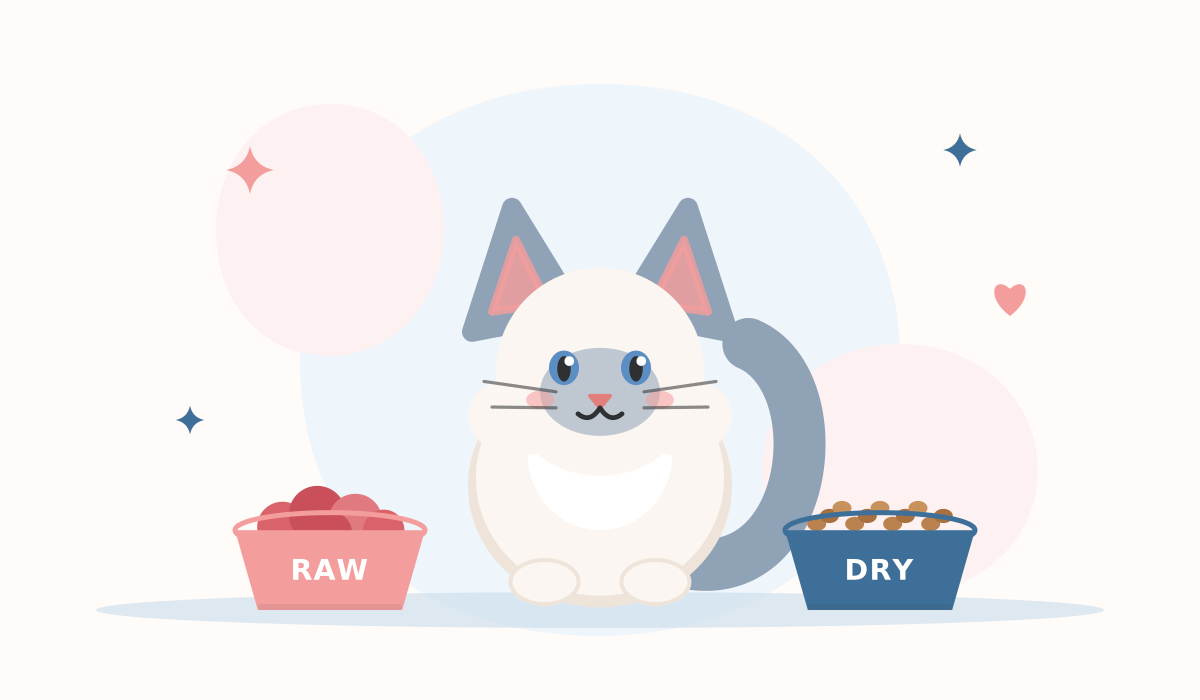
If there's one question we get asked more than any other, it's this: "How much should I be feeding my cat?" And honestly, it's a great question – because the answer keeps changing. A ten-week-old kitten, a lazy sterilised five-year-old and a queen feeding five babies are three completely different eaters.
I recently finished a feline nutrition course through PawPeds, and suddenly so much of what we do every day at Abrielle had numbers behind it. So I've put it all together here – in plain language, with a calculator further down so you can work out your own cat's portions. Pour yourself a cup of tea. 🍵
First, the cat on your couch is a little desert predator
It helps to remember what a cat actually is. Your cat's ancestors hunted small prey in dry, desert regions, and that still shapes how they eat today:
- Cats are true meat-eaters. They're brilliant at using protein and animal fat for energy, and need very little carbohydrate. A good cat food is mostly meat.
- Cats are poor drinkers. Wild cats got most of their water from their prey, so their thirst reflex is weak – a cat can be slightly dehydrated without feeling thirsty.
- Small stomach, short gut. That's why cats do best on several small meals rather than one big one.
How much energy does a cat need?
Vets and nutritionists start with the resting energy requirement – the calories a cat would burn lying on a cushion all day:
Don't let the little 0.75 scare you – the calculator does the maths. That number is then multiplied for your cat's stage of life: a growing kitten needs about two and a half times the resting amount, while a sterilised couch-lover needs about the resting amount and no more.

Kittens: little bodies, big appetites
Kittens live only on mum's milk for the first three to four weeks. Somewhere around week four or five they get curious – usually by walking straight through mum's food bowl first. 😄 Don't worry if one kitten takes longer than the others; they all get there.
From then until about 10 to 12 months, kittens need a lot of energy. They're building bones and muscle, and they play like it's their full-time job (it is). Don't be surprised if your nine-week-old eats as much in a day as your adult cat.
- Let them eat their fill at each meal until at least six months – not food out all day, but when you feed, let them finish.
- Feed often: four meals a day until about six months, then three.
- Raw or wet food: growing kittens can eat 6 to 10% of their body weight a day.
- Variety now saves trouble later. Cats are suspicious of new foods, so a kitten who meets raw, wet and dry – and different textures – grows into a much easier adult.
Sterilised adults: the easiest cats to overfeed
All Abrielle kittens go home already sterilised, so this is the stage most of our families spend the longest in – and where most cats quietly get chubby.
Sterilisation lowers a cat's energy needs by roughly 20%, and often their appetite goes up at the same time. That's a recipe for weight gain if you keep feeding kitten portions. From about 10 to 12 months, switch to adult amounts:
- Two measured meals a day (or three smaller ones) – no bowl that's always full.
- Raw or wet food: about 2 to 3% of body weight a day for most sterilised adults.
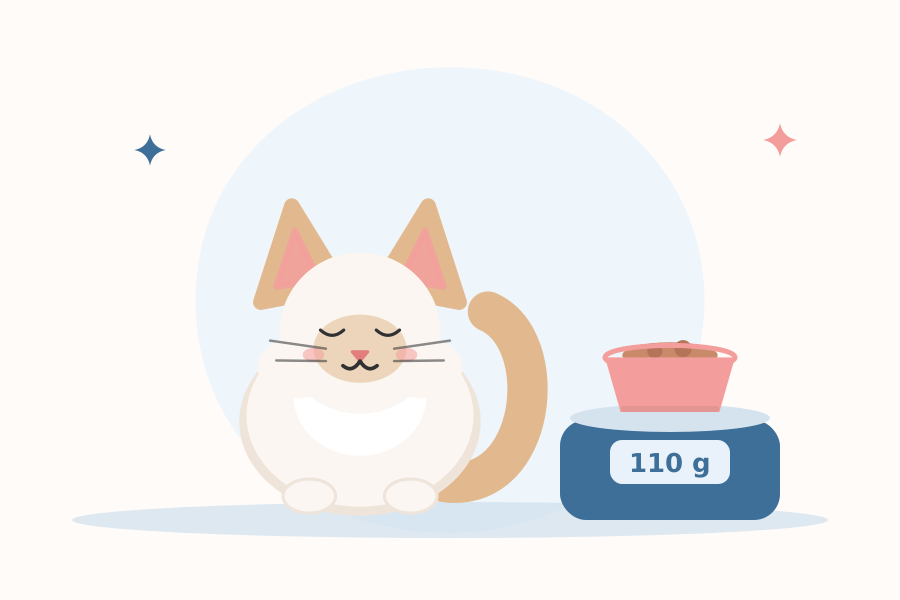
- Weigh, don't guess. A kitchen scale is the best R100 you'll ever spend on your cat.
- Play counts. Ten minutes with a wand toy twice a day burns calories and makes a happier indoor cat.
The knuckle test
Put your thumbs on your cat's spine and spread your fingers over the ribs, then compare the feeling with your own hand:

Breeding cats: studs, pregnant queens and nursing mums
Most families never need this part – but if you breed, or you're curious how we look after our cats, here's how it works.
Being entire burns energy. They need noticeably more food than a sterilised cat of the same size – a young, busy stud can need almost double the resting amount.
Weight goes up steadily from the start, and needs climb most in the last few weeks. Only about 40% of that weight comes off at the birth – the rest is a fat reserve for making milk.
The hungriest cats of all. At her peak, a queen makes milk equal to about 6% of her own body weight every day!
- Let a nursing mum eat as much as she wants, as often as she wants.
- Put food and water close to the nest, where she feels safe leaving her babies for a minute.
- Choose food rich in animal protein and fat – it goes straight into her milk. Research has linked a higher-fat diet in breeding queens to bigger, healthier litters.
- Water, water, water – making milk takes an enormous amount of fluid.
Raw, wet or dry – which is best?
There's no single right answer, and you don't have to choose just one. Here's the honest picture:
Closest to what cats evolved to eat, full of moisture, and chewing chunks helps keep teeth clean. It must be complete and balanced – plain mince isn't a meal. Thaw in the fridge, wash hands and boards, and never leave it out on a hot day.
Wonderful for kidneys and bladders, and the easiest way to get fluid into a cat that doesn't drink much.
Convenient and great for food puzzles, but very rich – portions are small and your cat must drink a lot more. Measure it carefully.

Water: the nutrient everybody forgets
A cat needs about 50 to 60 ml of water per kilogram of body weight every day – 200 to 240 ml for a 4 kg cat. Some comes from food, the rest they must drink. A cat on wet food may barely drink at all; a cat on only dry food needs to drink a lot. Even mild dehydration makes urine more concentrated, which raises the risk of bladder infections and stones.
- Use a wide, shallow bowl – many cats hate their whiskers touching the sides.
- Keep water at least a metre from food, and away from the litter box. A few bowls around the house is even better.
- Try a water fountain – lots of cats love running water.
- Change it daily, and more often on hot Highveld summer days.
Foods to keep away from your cat
Work it out: our cat feeding calculator
Choose your cat's stage of life and weight, and see roughly how many calories they need, how much that is in raw, wet or dry food, and how much water they still need to drink. For the most accurate answer, open "Food energy" and type in the kcal per 100 g from your own food's label.
Food energy (change to match your labels)
| Feeding only… | A day | Per meal | Still to drink |
|---|---|---|---|
| Raw food | – | – | – |
| Wet food | – | – | – |
| Dry food | – | – | – |
| Half raw or wet + half dry | – | ||
Feeding our halaal raw cat food? The calculator on that page works it out in containers per meal and per month, too.
The short version
- Kittens: lots of food, often – let them eat their fill at each meal, 3 to 4 times a day.
- Sterilised adults: measured meals, 2 to 3% of body weight in raw or wet food, and the knuckle test once a month.
- Breeding cats: more food, more fat, more protein – and nursing mums eat as much as they like.
- Everyone: mostly meat, plenty of water, at least one wet or raw meal a day, and your eyes and hands over any chart.
If you're ever unsure about your Abrielle kitten's food, send us a WhatsApp on 064 945 7712 – we genuinely love these questions. And if something seems off – your cat stops eating, vomits a lot or has an upset tummy for more than a day – please see your vet.